1

Fifty "Bab" Ballads: Much Sound and Little Sense — Reading Companion
(0 User reviews)
404
Project Gutenberg
1996
Not confirmed
English wit and humor; Humorous poetry, English
Readers of public-domain and historical texts
Project Gutenberg digital edition
en
Edition facts
Words
32,549
Reading time
142 min
Text sections
5
Before opening Fifty "Bab" Ballads: Much Sound and Little Sense — Reading Companion, the edition data offers a quick orientation: 32,549 words, 2 hr 22 min estimated reading time, and 5 detected text sections.
The text analysis averages about 20.3 words per sentence, while the detected sections provide another way to judge how the source is divided.
Project Gutenberg metadata also associates the work with “English wit and humor,” connecting these edition facts with the source record’s subject description.
Source:
Project Gutenberg record #757
W.S. Gilbert's self-edited collection of 50 comic ballads from Fun magazine, balancing absurd plots, precise meter, and satirical targets including clergy, military, and social pretensions, with the author's own illustrations.
Read the complete public-domain text at its original source.
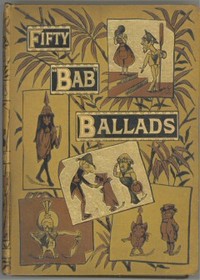
Read on Project GutenbergW.S. Gilbert's Fifty "Bab" Ballads: Much Sound and Little Sense collects the author's own selections from his earlier two volumes, weeding out what he considered hastily written impostors. The ballads first appeared in Fun under editor Tom Hood, and the preface notes that the first of the series, "The Yarn of the Nancy Bell," was rejected by Punch as "too cannibalistic for his readers' tastes." Gilbert's illustrations accompany the text, and the poems display a consistent formal control: regular stanzas, emphatic rhymes, and a deadpan narrative voice that treats outrageous premises—a baby who swaps identities, a captain who airs his legs to mermaids—as matter-of-fact.
Formal Precision and Comic Distance
The ballads rely on a steady, almost mechanical meter and rhyme scheme that never wavers, even when the content turns macabre or absurd. In "The Yarn of the Nancy Bell," the cannibalistic sailors recount their fate in jaunty anapests: "We all were as bold as could be." Gilbert's narrator rarely expresses surprise or moral outrage; instead, he reports events with the same flat tone whether describing a baby's vengeful thoughts or a bishop's ecclesiastical disputes. This formal control creates a gap between the outrageous events and the calm delivery, which is the primary source of humor. The poems often end with a punchline or a sudden twist, but the voice remains unflappable throughout.
Recurring Targets: Clergy, Rank, and Respectability
Several ballads take aim at institutional authority, especially the clergy. "The Rival Curates" and "The Bishop of Rum-Ti-Foo" satirize clerical competition and doctrinal absurdity. In "The Reverend Simon Magus," a preacher's magical tricks undermine his piety. Military and naval figures also appear frequently: Captain Reece is adored by his crew for his kindness, while Captain Capel Cleggs in "The Captain and the Mermaids" becomes an object of mermaid admiration and merman jealousy. Social climbing and mistaken identity recur in poems like "The Baby's Vengeance," where a swapped infant grows up to claim another's fortune. Gilbert consistently punctures pretension by taking it literally: characters act on absurd premises with perfect logic.
Self-Awareness and the Author's Hand
Gilbert's preface reveals a critical self-awareness: he withdrew ballads that showed "evidence of carelessness or undue haste," presenting only those he deemed worthy. The subtitle "Much Sound and Little Sense" signals the poems' deliberate frivolity. The author also illustrated the volume, adding another layer of authorial control. Within the poems, characters occasionally break the fourth wall or comment on their own absurdity. In "The Baby's Vengeance," the narrator describes himself as "a bad, blackhearted baby" with a knowing wink. This self-consciousness distinguishes the collection from mere nonsense verse; it is nonsense with a purpose, crafted by a writer who understood the mechanics of comedy and was unafraid to acknowledge them.
Readers approaching these ballads should attend to the interplay between form and content: the stricter the meter, the more outrageous the subject can become. Gilbert's targets are often specific—Victorian clergy, naval hierarchy, social climbers—but his method of literal-minded absurdity remains fresh. The poems reward reading aloud, where the rhymes and rhythms become fully apparent. The author's own illustrations, though not reproduced here, add another dimension to the humor. This collection represents Gilbert's own judgment of his best work in this vein, offering a concentrated dose of his comic sensibility.
I found myself thinking of my grandfather’s dog-eared copy of the Bab Ballads, how he’d read me “The Yarn of the Nancy Bell” with a straight face. That same gleeful absurdity surfaced later when I stumbled upon Poetry of the Anti-Jacobin Comprising the Celebrated Political and Satirical Poems, of the Rt. Hons. G. Canning, John Hookham Frere, W. Pitt, the Marquis Wellesley, G — A Reader’s Guide—same meticulous mischief, a century older, still winking at me from the shelf.
There are no reviews for this eBook.
There are no comments for this eBook.
Reader reflection
What was your reading experience?
Capture what you thought, learned, and would like to remember.
Your progress
0
/
10
2
Did this book hold your interest?
3
Would you pass this book on to a friend?
4
How easy was the book to follow?
5
How useful were the ideas in this book?
6
Did any part of the book stay with you emotionally?
7
Did you relate to its people, ideas, or situations?
8
Did the story or argument move comfortably?
9
What changed or sharpened your thinking?
10