1

Bab Ballads and Savoy Songs — Story, Setting & Ideas
(0 User reviews)
915
Project Gutenberg
2005
Not confirmed
English wit and humor; Humorous poetry, English; Songs, English -- Texts
Readers of public-domain and historical texts
Project Gutenberg digital edition
en
Edition facts
Words
26,081
Reading time
114 min
Text sections
5
For Bab Ballads and Savoy Songs — Story, Setting & Ideas, the stored edition analysis reports 26,081 words, 1 hr 54 min estimated reading time, and 5 detected text sections.
The text analysis averages about 17.9 words per sentence, while the detected sections provide another way to judge how the source is divided.
Project Gutenberg metadata also associates the work with “English wit and humor,” connecting these edition facts with the source record’s subject description.
Source:
Project Gutenberg record #15370
W. S. Gilbert's comic verse collection pairs absurd nautical yarns, legal satires, and Savoy Opera lyrics, marked by precise wordplay, rhythmic ingenuity, and a recurring tension between rigid social roles and anarchic logic.
Read the complete public-domain text at its original source.
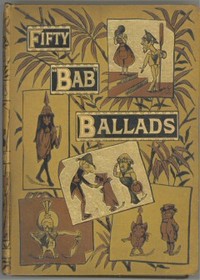
Read on Project GutenbergW. S. Gilbert's Bab Ballads and Savoy Songs collects his early comic ballads alongside lyrics from the Savoy Operas, revealing a writer who delights in puncturing institutional dignity with deadpan absurdity. The poems share a distinctive voice: a narrator who reports outrageous events—a man who is simultaneously a ship's entire crew, a bishop who marries a busman—with the calm assurance of a clerk filing a report. Gilbert's verse is metrically precise, often using internal rhyme and anapestic rhythms to propel his narratives forward. The collection showcases his fascination with legalistic language, social hierarchy, and the gap between official roles and human behavior.
The Logic of Nonsense
Gilbert's nonsense operates on a rigorous internal logic. In 'The Yarn of the Nancy Bell,' the elderly mariner claims to be 'a cook and a captain bold, / And the mate of the Nancy brig, / And a bo'sun tight, and a midshipmite, / And the crew of the captain's gig.' The narrator's literal-minded response—'I'll eat my hand if I understand / How you can possibly be' all those roles—sets up a punchline that is both absurd and, within the poem's cannibalistic premise, perfectly consistent. Similarly, 'The Bishop and the Busman' hinges on a syllogism: a bishop marries a busman to a lady, but the busman's professional duty to 'drive' his wife leads to a logical tangle. Gilbert treats these contradictions with the gravity of a legal argument, making the humor depend on the reader's recognition of the gap between formal rules and lived reality.
Musical and Metrical Craft
The Savoy Songs section demonstrates Gilbert's skill in matching verse form to character and situation. 'The Modern Major-General' uses rapid-fire rhyming couplets to convey the officer's encyclopedic but useless knowledge. 'The Policeman's Lot' employs a plodding rhythm that mirrors the constable's weary resignation. In 'The Sorcerer's Song,' the magician John Wellington Wells rattles off his inventory in breathless anapests: 'We've a first class assortment of magic; / And for raising a posthumous shade / With effects that are comic or tragic, / There's no cheaper house in the trade.' The verse often incorporates internal rhymes and lists—'prophesy / With a wink of his eye, / Peep with security / Into futurity'—creating a musical patter that emphasizes the absurdity of the content. Gilbert's metrical precision is never merely decorative; it reinforces the comic tension between formality and chaos.
Social Satire Through Role Reversal
Several poems in the collection use role reversal to critique social pretensions. 'The Ape and the Lady' presents an ape who 'bought white ties, and he bought dress suits, / He crammed his feet into bright tight boots' and renames himself 'Darwinian Man,' yet the lady rejects him because 'a Man, however well-behaved, / At best is only a monkey shaved!' The satire targets both the pretensions of social climbing and the reductive view of human nature implied by evolutionary theory. 'The British Tar' parodies jingoistic ideals of masculinity: the ideal sailor's 'fist should be ready to resist / A dictatorial word,' and his 'customary attitude' is a caricature of aggressive posturing. 'The Coming Bye and Bye' laments aging with a mock-heroic tone, cataloging physical decline—'Silvered is the raven hair, / Spreading is the parting straight'—in a way that undercuts the sentimental tradition of poems about lost youth.
Readers will find that Gilbert's humor rewards attention to his verbal dexterity and his willingness to let a joke unfold over several stanzas. The ballads and songs are best read aloud, as the rhythms and rhymes are designed for performance. Notice how he uses formal verse structures to contain—and heighten—the absurdity of his scenarios. The collection offers a window into Victorian comic sensibility, where wit and wordplay are valued over sentiment, and where the most ridiculous situations are treated with the utmost seriousness.
Old Gilbert’s verses know how rigid rules turn silly, yet the human pulse beneath them. So does an old schoolroom favorite, Poems Teachers Ask For, Book Two — Story, Setting & Ideas. Both sit quietly on my shelf, whispering that even in our most proper postures, a laugh or a tender tear waits to untangle us.
There are no reviews for this eBook.
There are no comments for this eBook.
Reader reflection
Your personal reading reflection
Build a private reading journal entry for this title.
Your progress
0
/
10
2
Did this book hold your interest?
3
How likely are you to recommend this book?
4
What was the reading difficulty like?
5
What did you think about the pace?
6
How original did the book feel?
7
Did it raise ideas you would like to talk about?
8
What did you appreciate most?
9
What is the main idea you are taking away?
10