1

Twas the Night before Christmas: A Visit from St. Nicholas — Themes and Context
(0 User reviews)
870
Project Gutenberg
2005
Not confirmed
Santa Claus -- Juvenile poetry; Christmas -- Juvenile poetry; Narrative poetry; Children's poetry, American
Readers of public-domain and historical texts
Project Gutenberg digital edition
en
Edition facts
Words
4,198
Reading time
19 min
Text sections
2
The source record for Twas the Night before Christmas: A Visit from St. Nicholas — Themes and Context measures this digital text at 4,198 words, 19 min estimated reading time, and 2 detected text sections.
The text analysis averages about 23.5 words per sentence, while the detected sections provide another way to judge how the source is divided.
Project Gutenberg metadata also associates the work with “Santa Claus -- Juvenile poetry,” connecting these edition facts with the source record’s subject description.
Source:
Project Gutenberg record #17135
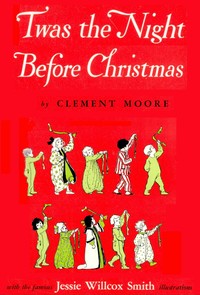
This editorial note examines the structure and imagery of Clement C. Moore's classic poem, focusing on the movement from quiet household to sudden arrival and the recurring visual details in Jessie Willcox Smith's illustrations.
Read the complete public-domain text at its original source.
Read on Project GutenbergThe poem opens with a household settled into stillness: “the children were nestled all snug in their beds.” This quiet scene is disrupted by a series of sounds—a clatter, the prancing of hooves, and St. Nicholas’s arrival. The narrative moves from inside to outside and back, tracking the speaker’s gaze through windows and across the lawn. Jessie Willcox Smith’s illustrations reinforce this spatial journey, showing the house from multiple perspectives.
From Stillness to Sudden Motion
The poem’s first lines establish a hushed interior: “not a creature was stirring, not even a mouse.” This calm is broken by “such a clatter” that the speaker springs from bed. The transition is abrupt, marked by the opening of the shutters and the sight of the moonlit snow. The pace quickens with St. Nicholas’s arrival, described in a series of rapid actions: he “sprang to his sleigh, to his team gave a whistle.” The contrast between the initial stillness and the ensuing commotion gives the poem its dramatic arc.
Recurring Visual Motifs
Several images appear repeatedly: the moon on the breast of the new-fallen snow, the miniature sleigh and tiny reindeer, and St. Nicholas’s “droll little mouth” and “broad face.” These details are not merely descriptive; they anchor the supernatural visitor in a tangible world. The illustrations by Smith echo these motifs, emphasizing the roundness of St. Nicholas’s figure and the sparkle of the snowy landscape. The poem’s visual consistency—the same objects described from different angles—creates a cohesive sensory experience.
Movement Between Interior and Exterior
The speaker’s perspective shifts fluidly. He is first inside, then at the window, then outside in imagination as he watches St. Nicholas ascend. The line “Away to the window I flew like a flash” marks a pivot point. Later, St. Nicholas “sprang to his sleigh” and “drove out of sight.” This back-and-forth movement mirrors the poem’s structure: each stanza alternates between the domestic interior and the magical exterior. The chimney becomes a threshold between these realms, with St. Nicholas entering and exiting through it.
The Role of Sound and Silence
Sound cues drive the narrative. The initial silence is broken by “the prancing and pawing of each little hoof.” St. Nicholas speaks not a word but “a wink of his eye” and a nod. The poem ends with his exclamation “Happy Christmas to all, and to all a good-night!”—the only direct speech. This economy of dialogue heightens the mystery. The illustrations complement this by showing St. Nicholas in motion rather than speaking, preserving the silent, swift quality of his visit.
Readers may find it useful to track how the poem’s rhythm—its anapestic meter—mirrors the galloping of reindeer. The illustrations by Jessie Willcox Smith, first published in 1912, add a visual layer that emphasizes the warmth of the interior scenes against the cold night. Pay attention to the way the poem balances the familiar (stockings, chimney) with the fantastical (a miniature sleigh, a flying reindeer team).
Some nights, when the house stills and a single lamp pools on the page, I think of that same hush in Moore’s poem—the mice asleep, the stockings hung. It’s the quiet before the stir, and I find it again, gentler still, in Phantasmagoria and Other Poems — Background and Themes, where Lewis Carroll’s ghost apologizes for his own footsteps. Two doorways into the same soft twilight.
There are no reviews for this eBook.
There are no comments for this eBook.
Reader reflection
How did this book work for you?
Your answers remain private and are stored only in this browser.
Your progress
0
/
10
2
How did the book work for you overall?
3
Would you encourage someone else to read it?
4
Did the language feel accessible?
5
How original did the book feel?
6
How valuable was this book for your own interests?
7
Did any part of the book feel personally relevant?
8
How clear did the writing feel?
9
Which lesson or insight stayed with you?
10