1

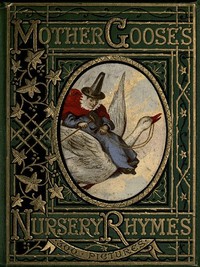
Mother Goose's Nursery Rhymes A Collection of Alphabets, Rhymes, Tales, and Jingles — Edition Insights
(0 User reviews)
2107
Project Gutenberg
2012
Not confirmed
Children's poetry; Nursery rhymes; Humorous poetry; Alphabet rhymes; Children's songs
Readers of public-domain and historical texts
Project Gutenberg digital edition
en
Edition facts
Words
21,039
Reading time
92 min
Text sections
7
The source record for Mother Goose's Nursery Rhymes A Collection of Alphabets, Rhymes, Tales, and Jingles — Edition Insights measures this digital text at 21,039 words, 1 hr 32 min estimated reading time, and 7 detected text sections.
The text analysis averages about 18.8 words per sentence, while the detected sections provide another way to judge how the source is divided.
Project Gutenberg metadata also associates the work with “Children's poetry,” connecting these edition facts with the source record’s subject description.
Source:
Project Gutenberg record #39784
This 1877 collection of Mother Goose rhymes, illustrated by Walter Crane, John Tenniel, and others, pairs familiar verses with varied visual styles. The excerpts show cumulative tales, alphabets, and nonsense jingles, but the catalog subject 'Science Fiction & Utopias' finds no support in the text.
Read the complete public-domain text at its original source.
Read on Project GutenbergThis 1877 edition of Mother Goose's Nursery Rhymes brings together alphabets, cumulative tales, and jingles, illustrated by a roster of Victorian artists including Walter Crane, John Tenniel, and Harrison Weir. The excerpts reveal a work built on repetition, rhythm, and incremental structure—most notably in the full text of “The House That Jack Built,” which chains a dozen agents from malt to farmer. The catalog assigns this book to “Science Fiction & Utopias,” a classification that finds no echo in the rhymes themselves, which dwell on domestic mishaps, animal encounters, and arithmetic complaints.
Cumulative Chains and Incremental Logic
The longest excerpt presents “The House That Jack Built” in its entirety, a cumulative rhyme that adds one element per stanza: malt, rat, cat, dog, cow, maiden, man, priest, cock, farmer. Each new verse recapitulates the previous chain, building a narrative through repetition. This structure, common in oral tradition, rewards memorization and participation. The rhyme’s logic is purely additive—no plot twist, no moral—just a growing list of agents and actions. Other excerpts, such as “The Queen of Hearts” and “Frog he would a-wooing go,” suggest the collection favors narrative rhymes over simple lullabies. The cumulative form appears again in “This is the Cock that crowed in the morn,” extending the chain to eleven links before closing.
Alphabets, Riddles, and Counting Rhymes
The table of contents lists “A Apple Pie” and “A B C, Tumble down D,” indicating alphabet rhymes are included. The excerpts offer a riddle: “Two legs sat upon three legs” (a man on a stool, with a dog stealing a leg of mutton). Counting appears in “Multiplication is vexation, Division is as bad; The Rule of Three perplexes me, And Practice drives me mad.” This schoolroom complaint sits alongside nonsense like “Three straws on a staff, / Would make a baby cry and laugh.” The variety suggests the book served both entertainment and early instruction, mixing pure play with sly commentary on learning.
Illustrators and Visual Variety
Five illustrators are credited: Sir John Gilbert, John Tenniel, Harrison Weir, Walter Crane, J. B. Zwecker, plus “others.” Tenniel, best known for Alice’s Adventures in Wonderland, and Crane, a leading figure in children’s book illustration, represent distinct visual approaches. The excerpts contain no images, but the title page and contents imply a richly illustrated volume. The 1877 publication date places it in a period of high-quality color printing for children’s books. Readers interested in Victorian illustration will find a sampler of styles, from Gilbert’s historical scenes to Crane’s decorative lines.
Readers approaching this edition should set aside the catalog’s “Science Fiction” label and instead attend to the rhymes’ oral qualities: repetition, rhythm, and incremental structure. The book rewards reading aloud, especially the cumulative tales. For those studying Victorian children’s literature, the illustrator lineup offers a cross-section of the period’s visual culture. The absence of any utopian or futuristic content in the excerpts confirms the classification is likely an error.
I sometimes think of the old Mother Goose, with its tumble of alphabets and jingles, as a kind of attic of rhyme—every verse a small, bright oddity stored for a rainy day. That same attic spirit lives on in Ballades and Rondeaus, Chants Royal, Sestinas, Villanelles, etc. — Inside the Classic, where fixed forms hold their playful, patient breath. Both whisper that order and nonsense share a friendly shelf.
There are no reviews for this eBook.
There are no comments for this eBook.
Reader reflection
Take a moment to reflect on this book
Create a short personal record of your experience with this book.
Your progress
0
/
10
2
Did this book hold your interest?
3
Would you recommend this book to another reader?
4
How easy was the book to follow?
5
How strongly did the book affect you emotionally?
6
How valuable was this book for your own interests?
7
How understandable was the text?
8
How closely did the book connect with your experience?
9
What is the main idea you are taking away?
10