1

A Visit From Saint Nicholas — Edition Insights
(0 User reviews)
617
Project Gutenberg
2005
Not confirmed
Santa Claus -- Juvenile poetry; Christmas -- Juvenile poetry; Narrative poetry; Children's poetry, American
Readers of public-domain and historical texts
Project Gutenberg digital edition
en
Edition facts
Words
3,701
Reading time
17 min
Text sections
1
The catalog record for A Visit From Saint Nicholas — Edition Insights provides practical reading context through 3,701 words, 17 min estimated reading time, and 1 detected text section.
The text analysis averages about 25.7 words per sentence, while the detected sections provide another way to judge how the source is divided.
Project Gutenberg metadata also associates the work with “Santa Claus -- Juvenile poetry,” connecting these edition facts with the source record’s subject description.
Source:
Project Gutenberg record #17382
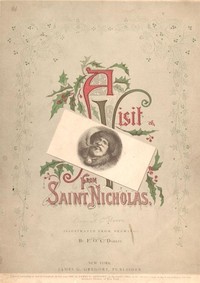
An editorial note on Clement Clarke Moore's 'A Visit From Saint Nicholas,' examining the poem's diction, rhythm, and descriptive choices that established the modern image of Santa Claus. Observations are drawn from the 1862 illustrated edition by F.O.C. Darley.
Read the complete public-domain text at its original source.
Read on Project GutenbergThe poem opens with a familiar domestic tableau: stockings hung, children asleep, and parents settling for the night. But the narrator's sudden spring from bed—'I sprang from my bed to see what was the matter'—introduces a shift from quiet expectation to energetic curiosity. The language throughout balances colloquial warmth with precise physical description, as when St. Nick's 'little round belly' shakes 'like a bowl full of jelly.' This blend of the ordinary and the whimsical anchors the supernatural visit in a recognizable household.
Rhythm and Sound as Narrative Engine
The poem's anapestic meter—two unstressed syllables followed by a stressed one—creates a galloping rhythm that mirrors the sleigh's motion. Moore reinforces this with internal rhymes and alliteration: 'More rapid than eagles his coursers they came, / And he whistled, and shouted, and called them by name.' The repeated 'dash away' in the reindeer's names adds a percussive urgency. This rhythmic consistency propels the reader from the initial quiet through the clatter on the lawn to the final ascent up the chimney.
Visual Detail and the Construction of St. Nicholas
Moore builds St. Nick's appearance through a series of vivid, almost catalog-like details: 'His eyes how they twinkled! his dimples how merry! / His cheeks were like roses, his nose like a cherry.' The similes are homely and concrete—roses, a cherry, a bow, snow—making the figure both fantastical and familiar. The pipe smoke 'encircled his head like a wreath' and the soot-tarnished fur suggest a being who has just traveled through a chimney, grounding the magic in physical evidence. These choices collectively define the visual archetype that persists today.
The Narrator's Role as Witness
The poem is told from a first-person perspective, but the narrator remains largely passive. He observes, laughs 'in spite of myself,' and receives a wink that signals 'I had nothing to dread.' St. Nicholas 'spoke not a word' and works silently. This asymmetry emphasizes the visitor's otherworldly competence and the narrator's role as awestruck chronicler. The final image—St. Nick laying his finger 'aside of his nose' and rising up the chimney—leaves the reader with a gesture of complicity rather than explanation.
The 1862 Edition and Darley's Illustrations
This Project Gutenberg edition reproduces the 1862 volume illustrated by Felix Octavius Carr Darley. Darley's drawings, engraved by N. Orr, complement Moore's text by visualizing the scenes: the sleigh on the roof, the reindeer, St. Nick's entrance. The interplay between word and image reinforces the poem's descriptive precision. Readers can observe how Darley interprets phrases like 'a bundle of toys he had flung on his back' and 'the stump of a pipe he held tight in his teeth,' adding a visual dimension to Moore's verbal sketch.
Moore's poem endures not because it invents a new mythology, but because it renders the familiar with such tactile specificity. The 1862 edition offers a chance to see how early illustrators shaped the visual legacy of the text. Readers may wish to compare Darley's interpretations with their own mental images, noting where the illustrations align with or diverge from the poem's descriptions.
I remember nights by the old coal stove, tracing Darley’s Saint Nicholas through those lamplit pages—that jolly warmth meant to still a child’s heart. And then, years later, I found myself turning the leaves of A Treasury of War Poetry: British and American Poems of the World War 1914-1917 — Edition Insights, where every measured line carries a different kind of hush, and I thought, how quietly we hold our tenderness.
There are no reviews for this eBook.
There are no comments for this eBook.
Reader reflection
Your personal reading reflection
Build a private reading journal entry for this title.
Your progress
0
/
10
2
Was reading this book enjoyable?
3
Is this a title you would suggest to others?
4
How easy was the book to follow?
5
Which element worked best for you?
6
Do you expect to return to this book?
7
How useful did the reading feel?
8
Did you relate to its people, ideas, or situations?
9
What did this book teach you most?
10